Guide
Beginner Boxing Workout: A Plan You Can Keep
A beginner boxing workout built on the basics: warm-up, stance, jab and cross, shadowboxing rounds and bag work. Sessions you can do at home, no partner.
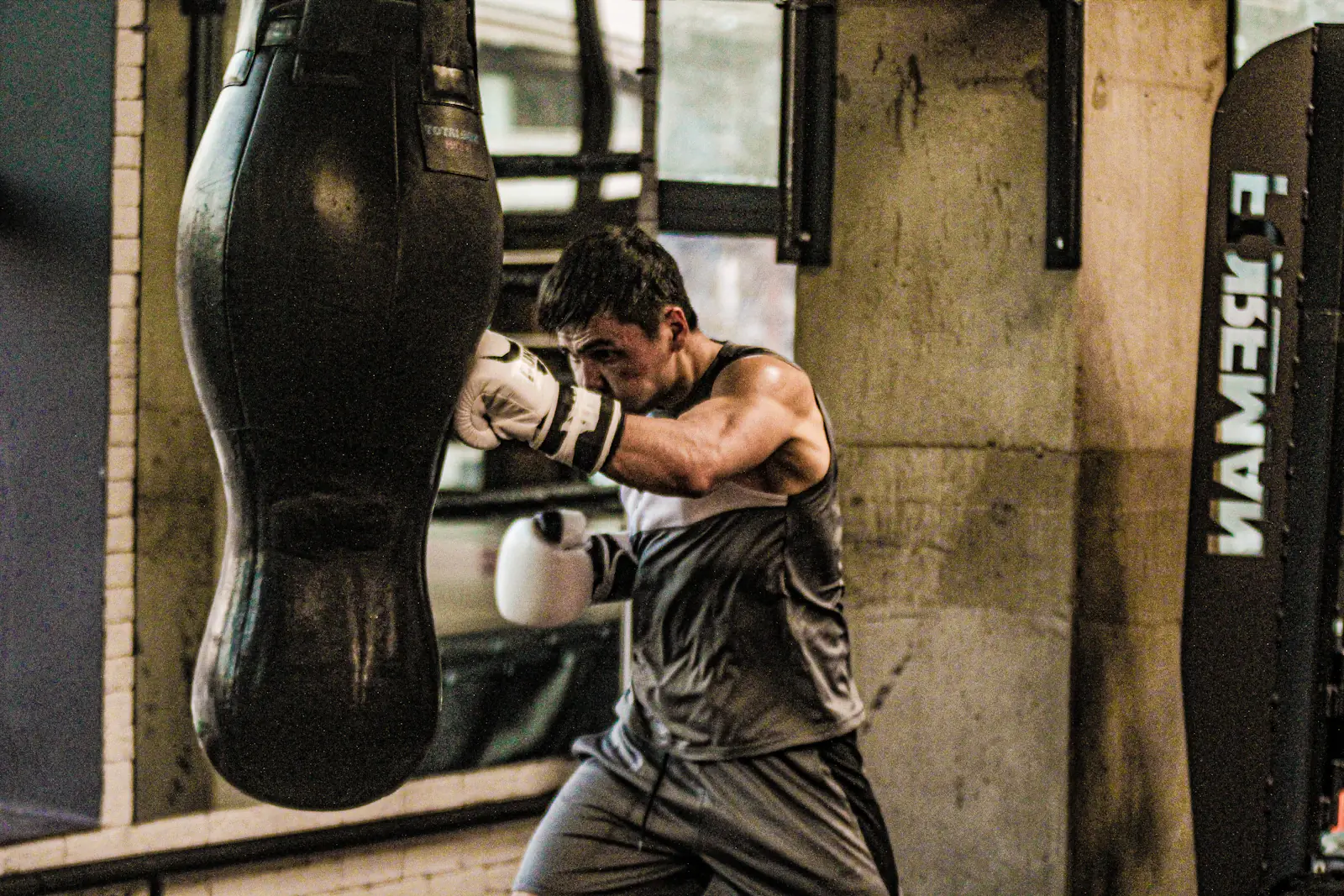
Most beginner boxing workouts online are conditioning circuits with punches bolted on. That builds fitness and teaches you almost nothing about boxing.
This one is built the other way round: technique first, conditioning as a by-product. It runs about 45 minutes without a bag, an hour with one, and needs no partner.
| Block | Time | What you do | What it builds |
|---|---|---|---|
| Warm-up | 8 min | Jump rope, joint circles, light shadow | Blood flow, shoulders, ankles |
| Stance and footworkTop pick | 6 min | Step-drag in four directions, no punches | The base everything else sits on |
| Jab and cross | 9 min — 3 rounds | Slow reps in the mirror, then at pace | Alignment, hip rotation, return |
| Shadowboxing | 12 min — 4 rounds | Combinations, movement, one slip per combo | Timing, conditioning, habits |
| Bag work (optional) | 12 min — 4 rounds | Same combinations, real contact | Power, endurance of output |
| Cool-down | 8 min | Core, shoulders, stretching | Recovery, injury prevention |
Before anything: three rules
Three sessions a week, never consecutive days. Wrists, elbows and shoulders need the rest, and bone adaptation cannot be rushed.
Wrap your hands, even alone, even “going light”. The sessions where people get hurt are exactly the ones where they decided it did not matter. See how to wrap your hands.
Film one round a week. Not for the highlight — to check three things: does the rear hand come back to your cheek, does your chin stay tucked, do your feet cross. Those are the three flaws almost every self-taught boxer develops.
Warm-up — 8 minutes
Not optional, and not stretching. You are warming joints that are about to absorb impact.
Jump rope, 5 minutes, or step in place if you have no rope and neighbors below. Steady pace, small hops.
Joint circles, 3 minutes: ankles, hips, shoulders, wrists, neck. Twenty slow rotations each way. Wrists and shoulders matter most — they take the load.
Save static stretching for the end. Stretching cold muscle before impact work does nothing useful and can do harm.
Stance and footwork — 6 minutes
The block everyone skips, and the one that separates people who look like boxers from people who look like they are punching.
The stance. Orthodox: left foot forward, right foot back and at roughly 45 degrees, feet about shoulder width, weight even, knees soft. Southpaw is the mirror. Hands at cheek height, elbows in against the ribs, chin down.
The step-drag. Move forward by stepping with the front foot and dragging the rear. Backward by stepping with the rear and dragging the front. Left and right the same way — always leading with the foot in the direction you are going.
Never cross your feet. For six minutes, do nothing but move in four directions and check that.
Jab and cross — 9 minutes
Three rounds of three minutes. Mirror if you have one, phone propped against a wall if you do not.
Round one: the jab, slow. Lead hand goes straight out and straight back, shoulder rising to protect the chin, rear hand glued to the cheek. Twenty slow reps, then twenty at half speed. The jab is not a power punch — it measures distance and opens the way.
Round two: the cross. Rear hand, straight down the middle. The power comes from the rear foot pushing and the hips rotating, never the arm alone. Pivot the rear heel outward as you throw.
Round three: one-two. Jab, cross, both hands back to the guard. Slowly. Then add a step forward on the jab.
What to watch: the hand that stays out too long, the chin that lifts on the cross, the elbow that flares.
Shadowboxing — 12 minutes
Four rounds of three minutes, one minute rest. This is the core of the session.
- Round 1 — movement plus jab only.
- Round 2 — one-twos, adding a step in and out on each.
- Round 3 — free combinations, with one slip or roll after every combination. This is where defense becomes a habit instead of an afterthought.
- Round 4 — high intensity, guard held. The guard drops when you tire; that is the point of the round.
Throw at a real target height in your head, not into empty air above you. Return every punch to the guard before the next one starts.
Bag work — 12 minutes, once the basics hold
Add this after two to three weeks, not on day one. And for the first three sessions, work at 50 percent — wrists and knuckles need to adapt.
Four rounds, same combinations as your shadow rounds. The bag does not teach you anything new; it tells you whether what you learned holds up against resistance.
Wraps and gloves both, always. Never bare knuckles, never in MMA-style mitts.
If you do not have a bag yet, do not rush it — see boxing at home for when it is actually worth buying.
Cool-down — 8 minutes
Core, 4 minutes: plank, side planks, a set of hollow holds. Boxing is transmitted through the trunk; a weak core caps everything else.
Stretching, 4 minutes: shoulders, chest, hip flexors, calves. Now is when static stretching earns its place.
Progressing after the first weeks
Weeks 1 to 3 — the plan above, as written. Do not add anything.
Weeks 4 to 8 — add the hook and the uppercut, one per week, in the technique block. Extend shadow to five rounds.
Week 8 onwards — add a third punch to your combinations, add rounds rather than length, and start working a double-end bag if you have one.
And around here, go to a gym. Two months of solid home work makes a first class much more useful, and a coach will fix in ten minutes what six months alone will not.
What to remember
Technique first, conditioning as a side effect. Warm-up, footwork, two punches, shadow, then bag — three times a week with a rest day between.
Wrap your hands every session. Film one round a week. Add punches by the week, not by the day.
When you are ready to set up properly at home, boxing at home covers space, noise and what to buy in what order.
Frequently asked questions
How long should a beginner boxing workout be?
Forty-five minutes to an hour, three times a week. Longer sessions are not better at the start — form breaks down as you tire, and what you drill while tired is what you learn. Two focused thirty-minute sessions beat one exhausting two-hour one.
Can you learn boxing without a coach?
You can build conditioning, footwork and the mechanics of the punches. You cannot learn distance, timing or how to read another person — those require someone in front of you. The real risk of training alone is automating a flaw nobody corrects, which is why filming yourself weekly matters more than any piece of equipment.
What should a beginner boxer do every day?
Nothing every day — that is how beginners get tendon problems in the wrists and elbows. Three punching sessions a week with a rest day between them is the sustainable pattern. On off days, jump rope, core work or a walk are all fine.
How long before you see progress in boxing?
Conditioning improves within two to three weeks. Footwork and guard start to feel natural around six to eight weeks. Timing and distance take months and really need a partner. If your shoulders stop burning after two rounds of shadow, that is progress, even if the punches do not look different yet.
Related reading
TrainingBoxing at Home: How to Train Without a Gym
Boxing at home, step by step: space, minimal gear, shadowboxing, bag work and a weekly plan you can keep. What you need and what you can skip.
How to Wrap Your Hands for Boxing
How to wrap your hands for boxing, step by step, with the mistakes that leave knuckles and wrists unprotected. Traditional wraps vs quick wraps.